
Most people do not fail because they choose wrongly. They fail because they never question what they are choosing.
Thousands of years ago, the Katha Upanishad presented a story that still confronts the modern mind. It raises a question that has not lost its urgency: why does fulfilment fade even after success is achieved?
Human life is structured around pursuit. Wealth, power, recognition, pleasure, and security become the visible goals. Yet even when they are attained, something subtle remains unsettled. Desire changes form, but the sense of incompleteness returns.
The ancient sages saw this clearly. Suffering does not arise simply from having too little. It arises from holding on to what cannot last.
The Story of Nachiketa
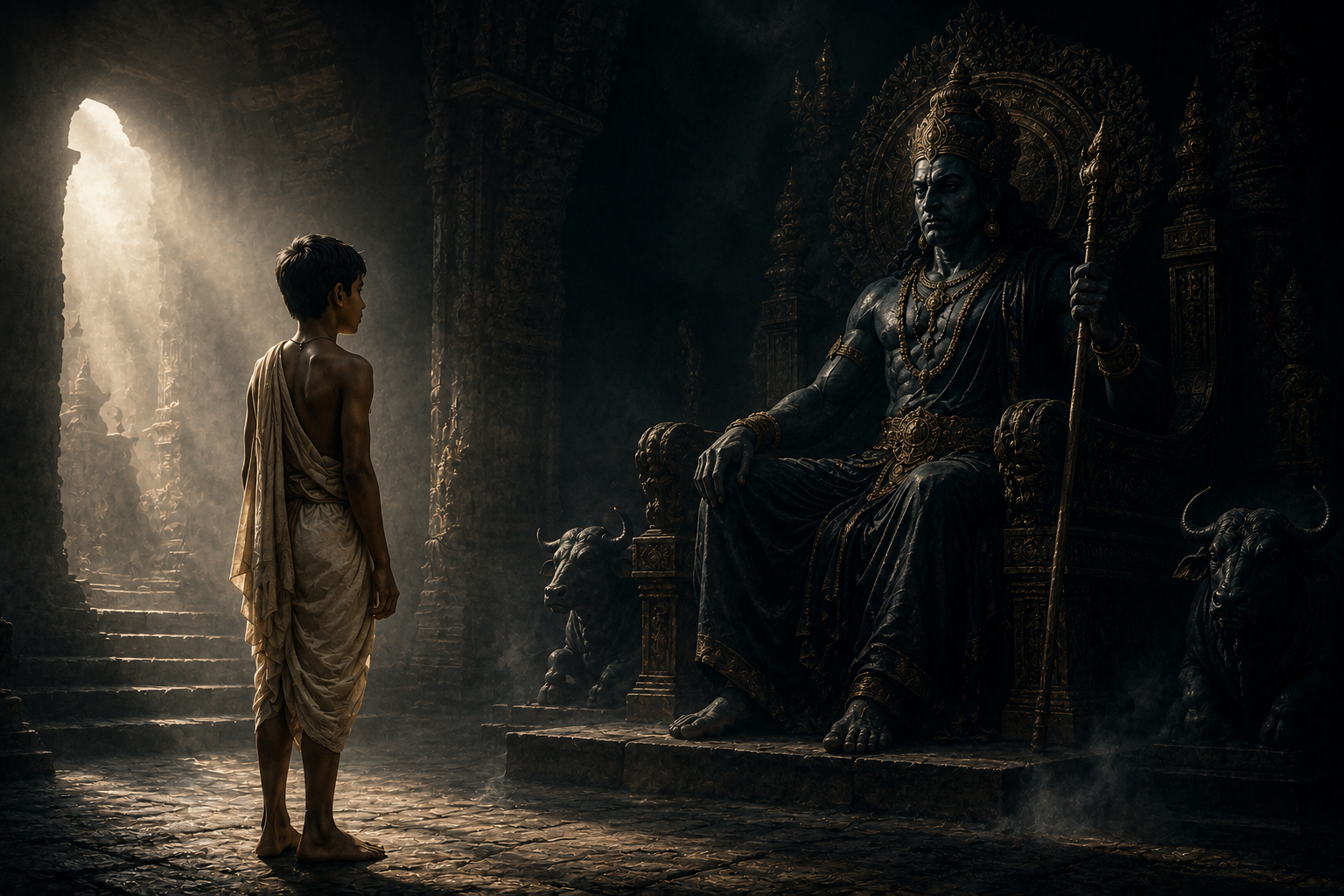
The story begins with a young boy named Nachiketa. His father was performing a grand ritual, giving away wealth in charity. To everyone watching, it appeared noble and complete. Fires burned, prayers were recited, and the act carried the weight of virtue.
But Nachiketa saw what others overlooked. The gifts being offered were old, weak, and of little worth. The act had the form of truth, but not its substance.
He asked a simple question. “To whom will you give me?”
His father ignored him. Nachiketa asked again, and then a third time. Each repetition sharpened the discomfort. Finally, unable to face what was being revealed, his father said in anger, “I give you to Death.”
Most would dismiss such words. Nachiketa did not. He took them seriously, not out of fear, but out of integrity. If something had been said, it had to be faced.
Without hesitation, he left to meet Yama, the lord of death.
The Waiting
When Nachiketa arrived, Yama was not there. There was no guidance, no reassurance, no comfort.
The boy waited.
One day passed. Then two. Then three.
Without complaint. Without distraction. Without turning away.
This is where the story becomes rare. Most people seek to escape discomfort immediately. Nachiketa remained.
The Test
When Yama returned, he saw something unusual. A young mind standing at the threshold of death, steady and unmoved.
As a mark of respect, he offered three boons. The first two addressed ordinary concerns. Then came the third.
Nachiketa asked what most people spend their lives avoiding. What happens after death? Does anything remain, or does everything end? It was not curiosity. It was a refusal to live without knowing.
Instead of answering, Yama tested him.
He offered everything people desire:
- Wealth beyond imagination
- Long life
- Power and status
- Endless pleasure
Everything that defines success was placed before him.
The condition was simple:
Take all of this, and leave the question.
The Refusal
Nachiketa did not hesitate.
He saw clearly. Not the attractiveness of what was offered, but its nature.
All of it would pass. Wealth fades. Pleasure ends. Life itself comes to a close. None of it could answer what he was seeking.
So he refused.
Not out of rejection, but out of understanding.
The Teaching
Only then did Yama teach him.
He said there are two paths in life. One is what is pleasant, immediate, and comforting. The other is what is true.
Most people choose what feels good in the moment.
Very few remain with what leads to truth.
Everything Nachiketa had refused belonged to what changes. It appears, stays briefly, and disappears. But what he was seeking is not part of that.
There is something that does not come and go. Something that is not born and does not die. Something that remains when everything else falls away.
That is what he pointed toward.
Why This Still Matters Today
Modern life intensifies the same pattern. Success is constantly pursued. Identity is built on validation. Attention is fragmented.
There is always something to achieve, consume, or display.
The mind remains occupied long enough to avoid deeper questions.
And yet, even after achieving what once seemed meaningful, something remains incomplete.
Not because something is missing, but because what is being sought cannot be found in what changes.
This is the difference between living through accumulation and living through understanding.
The Rare Clarity
Nachiketa reveals a rare possibility. The ability to see clearly and not be carried away.
He does not reject life. He understands its limits.
He refuses to exchange truth for comfort.
In today’s world, the real challenge is not lack of opportunity. It is the constant availability of distraction.
There is always something to avoid stillness.
And so the deeper question is postponed.
Again and again.
But Nachiketa did not postpone.
That is his power.
Where Everything Changes
He stayed with the question until everything else lost its weight.
In the end, the story is not about what he discovered.
It is about what he refused.
He refused distraction.
He refused comfort in place of truth.
He refused to settle for what fades.
And that is where everything begins to change.
Not when you achieve more,
but when you see clearly what is not worth chasing.
Source: Katha Upanishad with Śaṅkara Bhāṣya – WisdomLib


