
This article was originally published on Medium and summarizes the key ideas of the paper “The Knower Centred Model of Consciousness (KCM): A Typed Ontology and Empirical Research Framework.”
Consciousness research has become increasingly sophisticated in describing the structure of experience. Yet the most basic feature of experience is often left unthematized: the fact that anything appears at all — and appears to someone. The Knower Centred Model of Consciousness (KCM) begins from this simple but profound observation and proposes a subject-first framework in which the Knower is treated as the necessary condition for the appearance of any world.
A new paper titled “The Knower Centred Model of Consciousness (KCM): A Typed Ontology and Empirical Research Framework,” recently released on the Open Science Framework and PhilArchive, develops this idea into a formal philosophical and empirical framework. Rather than attempting to derive consciousness from physical or informational structures, the model distinguishes between the presence of the knower and the organization of experience. Neural activity, computational processes, and informational organization can describe how experience is structured, but not why presence exists at all.
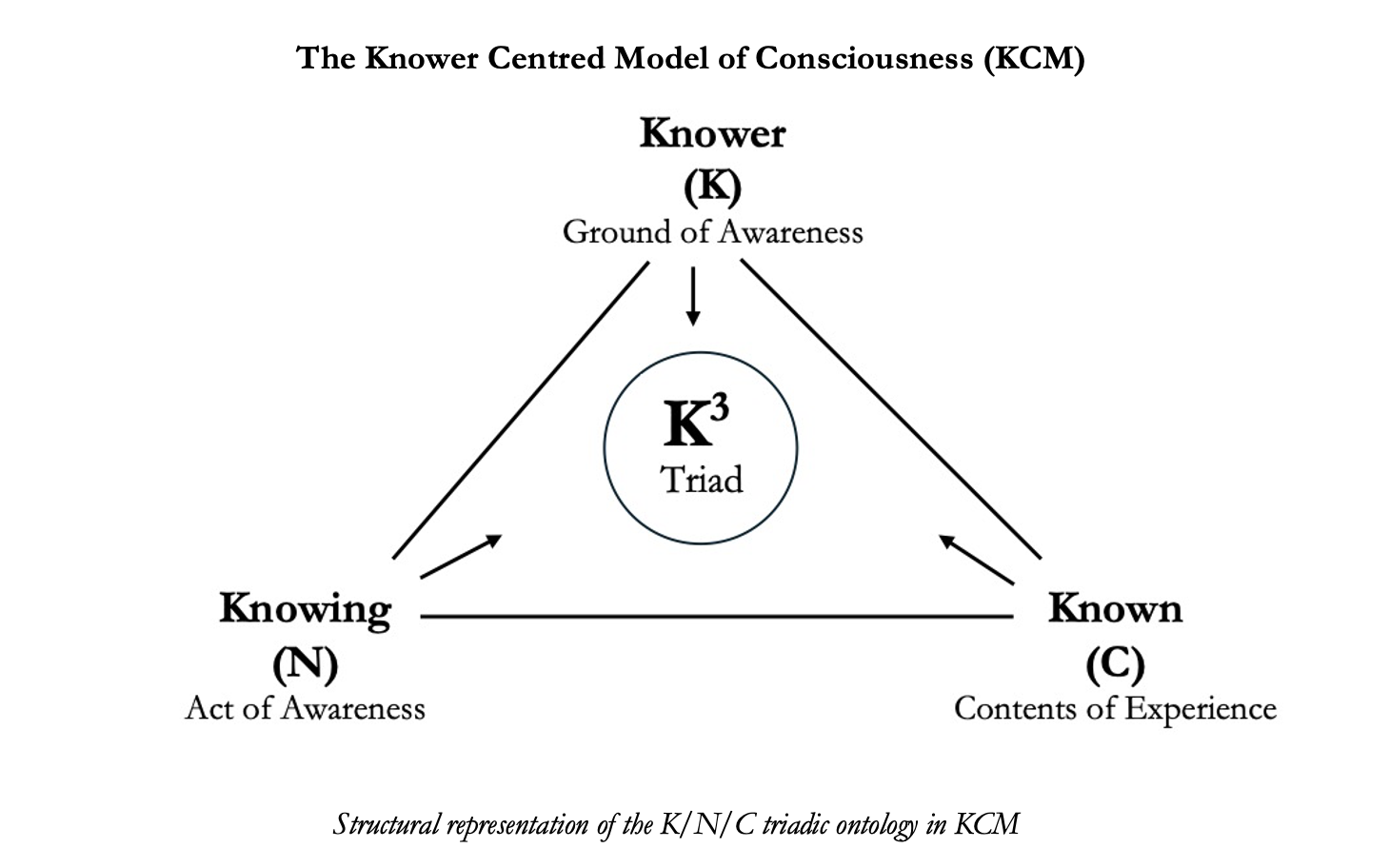
At the centre of the model is the K³ Triad, the minimal structure of experience:
- Knower (K) — the witnessing presence
- Knowing (N) — the relational act of awareness
- Known (C) — the contents and structures of experience
Every episode of experience manifests through this triadic relation.
To preserve conceptual clarity, KCM introduces a typed ontology. All explanations must be specified at one of three levels:
- K-level — presence or subjectivity
- N-level — relational processes such as attention, access, or inference
- C-level — experiential content and neural or physical structure
This typing rule prevents a common category error in consciousness research: inferring the existence of a subject from the complexity of informational or neural structures alone.
The framework also introduces a key interpretive constraint:
The Modulation Principle
Neural and physical dynamics modulate the organization of experience (C) and may index modes of knowing (N), but they do not generate, eliminate, or duplicate the Knower (K). Empirical measurements therefore describe the structure of appearance, not the existence of the subject itself.
The paper formalizes this subject-centred approach through five foundational axioms:
- Ontological Primacy of the Knower — presence is the necessary condition for any appearance or knowledge claim.
- Experience-First Ontology — all phenomena are encountered as structured appearances within awareness.
- The K³ Triad — experience is irreducibly structured as Knower, Knowing, and Known.
- Irreducibility of Consciousness — the Knower cannot be reduced to physical or informational structures.
- Co-Constructive Reality — reality arises relationally through the interaction of Knower, Knowing, and Known.
Beyond philosophical clarification, the paper outlines an empirical research program integrating first-person phenomenological methods with third-person scientific investigation. It also proposes testable predictions concerning artificial intelligence, minimal-content awareness states, anaesthesia, and split-brain research.
At its core, the proposal rests on a simple but profound insight:
All science takes place within experience — therefore any science of consciousness must account for the presence to whom the world appears.
The article provides a brief introduction to the framework; the full technical formulation appears in the research paper below.
DOI: https://doi.org/10.31219/osf.io/kb9p3
Paradise of Change – A Centre for Body, Mind and Consciousness
https://changeparadise.com


